
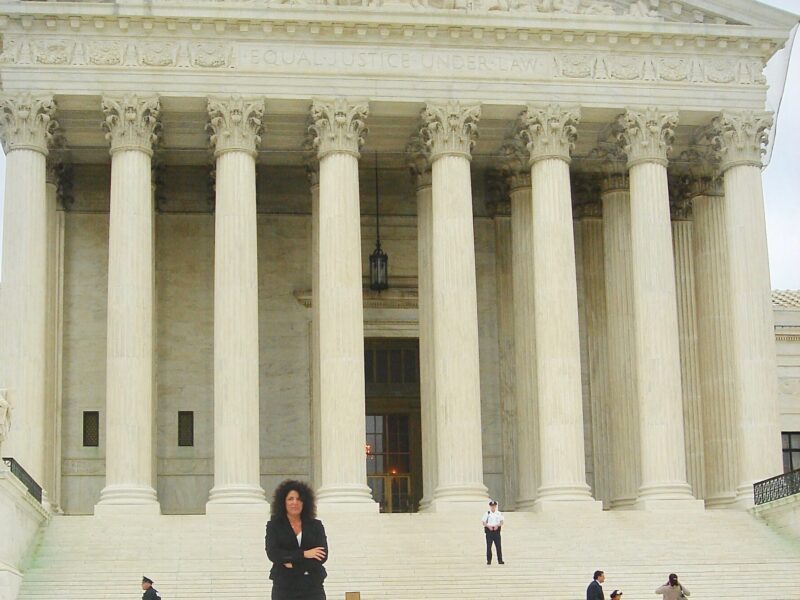
Appeals & U.S. Supreme Court
Susan Chana Lask is an appellate and constitutional litigator whose practice includes high-stakes civil rights and statutory appeals in federal and state courts.
Her work includes serving as Counsel of Record in a U.S. Supreme Court civil rights case and representing appellants in published U.S. Court of Appeals decisions addressing the scope of federal civil rights protections.
This page highlights selected appellate matters that illustrate the role of Ms. Lask’s appellate advocacy in shaping legal standards, preserving constitutional protections, and obtaining reversals and remands in cases.
Selected Appeals and Constitutional Matters
U.S. Supreme Court: Florence v. Board of Chosen Freeholders of the County of Burlington, 566 U.S. 318 (2012)
Ms. Lask served as Counsel of Record in Florence, a civil rights action brought under 42 U.S.C. § 1983 challenging the constitutionality of strip-search practices for individuals arrested for minor offenses and admitted to jails. The Supreme Court granted certiorari and, after argument, affirmed the judgment below with a direction that only those persons entering the general population of the prison are subject to the strip searches.
The Supreme Court’s docket reflects extensive amici curiae, including (among others) the American Bar Association and the National Association of Criminal Defense Lawyers.
Second Circuit: Christiansen v. Omnicom Group, Inc., No. 16-748 (2d Cir. Mar. 27, 2017)
Ms. Lask represented plaintiff-appellant Matthew Christiansen in a published Second Circuit decision addressing Title VII and gender-stereotyping theory under Price Waterhouse v. Hopkins. The panel reversed the dismissal of the Title VII claim and remanded for further proceedings, and Ms. Lask ultimately won a substantial seven figure settlement.
The Circuit Court panel was Chief Judge Robert A. Katzmann, Circuit Judge Debra Ann Livingston, and District Judge Margo K. Brodie (sitting by designation)
Appellate Approach
Appeals require discipline and proper issue selection, rigorous record review, and a strategy designed for the standard of review. Ms. Lask’s appellate work is structured to:
(i) identify reversible legal error; (ii) preserve dispositive issues; (iii) present a concise and credible narrative; and (iv) frame relief in a way that is enforceable on remand and defensible on further review.